Stay updated on what is trending in health. Discover tips and resources for a healthier, balanced life.

Nasal Sprays for Nasal Congestion: Types, Benefits and More
Nasal sprays work to relieve congestion from colds, allergies & sinus issues. Discover the different types, how they work, and how to use them safely.
WELLNESS
Dr. S. Ali
1/10/20266 min read
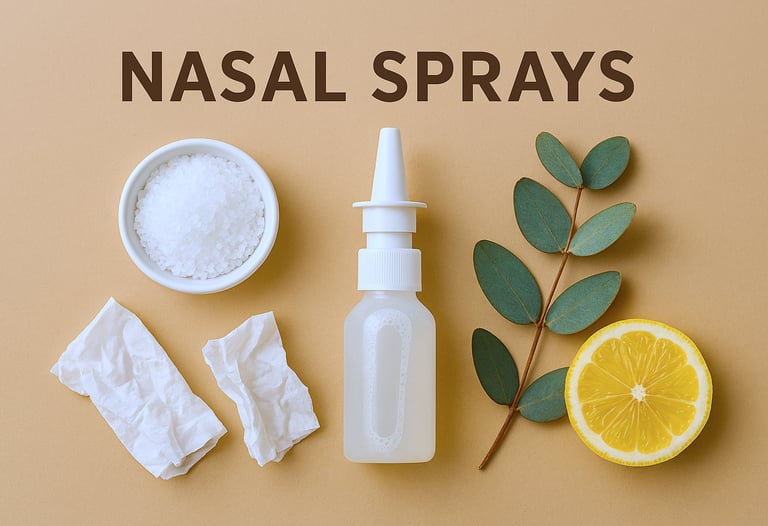
A blocked or stuffy nose can make even simple things — like speaking, sleeping, eating, or concentrating — feel miserable. Whether it’s due to a cold, allergies, sinus infection, or dry air, nasal congestion is one of the most common complaints people search for online.
Nasal sprays are often the first solution people reach for. But not all nasal sprays are the same — and using the wrong one, or using it incorrectly, can actually make congestion worse.
Let’s break it down in a clear, practical way.
What Causes Nasal Congestion?
Nasal congestion happens when the lining of your nasal passages becomes inflamed and swollen. Common causes include:
Common cold and flu
Allergic rhinitis (hay fever)
Sinusitis
Dry air or environmental irritants
Overuse of certain nasal sprays
Hormonal changes (including pregnancy)
Understanding the cause helps determine which nasal spray will actually help.
Types of Nasal Sprays Used for Congestion
1. Saline Nasal Sprays (Salt Water Sprays)
Best for: Mild congestion, dryness, daily use, children, and pregnancy
Saline sprays contain sterile salt water. They do not contain medication.
How they help:
Moisturize dry nasal passages
Thin thick mucus
Help flush out allergens, dust, and irritants
Pros:
Safe for long-term use
No rebound congestion
Can be used multiple times a day
Cons:
Relief may be gentle, not immediate
Good to know: Saline sprays are often recommended by doctors as a first-line option and can be used alongside other treatments.
2. Decongestant Nasal Sprays
Common examples: Oxymetazoline, Xylometazoline
Best for: Short-term, severe nasal blockage
These sprays work by shrinking swollen blood vessels inside the nose, which opens up the airway quickly.
How they help:
Provide fast relief (often within minutes)
Reduce nasal swelling
Pros:
Very effective short-term
Helpful at night or during flights
Cons and warnings:
Should not be used for more than 3–5 days
Overuse can cause rebound congestion (rhinitis medicamentosa)
Can lead to dependency if misused
Important: These sprays treat symptoms, not the underlying cause.
3. Steroid (Corticosteroid) Nasal Sprays
Common examples: Fluticasone, Mometasone, Budesonide
Best for: Allergic rhinitis, chronic nasal congestion, nasal polyps
These sprays reduce inflammation over time.
How they help:
Calm inflamed nasal tissues
Reduce swelling, mucus production, and sneezing
Pros:
Safe for long-term use when used correctly
Treat the underlying inflammation
Very effective for allergies
Cons:
Do not give instant relief
May take a few days to show full benefit
Professional tip: Proper spray technique matters — aim slightly away from the nasal septum to reduce irritation.
4. Antihistamine Nasal Sprays
Best for: Allergy-related nasal congestion
These sprays block histamine, the chemical responsible for allergy symptoms.
How they help:
Reduce itching, sneezing, and runny nose
Help with congestion related to allergies
They may be used alone or in combination with steroid sprays in some cases.
5. Combination Nasal Sprays
Some sprays combine a steroid with an antihistamine.
Best for: Moderate to severe allergic rhinitis
These are usually prescription-only and recommended when single treatments are not enough.
Which Nasal Spray Should I Use?
Choosing the right nasal spray depends on what’s causing your congestion. Use this simple guide to avoid overuse and get the relief you actually need.
🔹 If your nose feels dry, crusty, or irritated
Use: Saline spray or saline rinse
Why it helps: Moisturizes nasal passages and washes out dust, allergens, and mucus
How long: Safe for daily, long-term use
Good to know: No rebound congestion, no medication
🔹 If you have a cold or flu and need quick relief
Use: Decongestant spray (e.g., xylometazoline, oxymetazoline)
Why it helps: Shrinks swollen blood vessels for fast breathing relief
How long: Maximum 3–5 days only
Warning: Longer use can cause rebound congestion and dependence
🔹 If you have allergies or hay fever
Use: Steroid nasal spray (e.g., fluticasone, mometasone)
Why it helps: Reduces inflammation and allergy symptoms at the source
How long: Can be used daily during allergy season
Important: Takes 2–3 days to work — not instant relief
🔹 If sneezing and itching are your main symptoms
Use: Antihistamine nasal spray
Why it helps: Blocks histamine release from allergic reactions
How long: As directed; suitable for allergy-related symptoms
Tip: Can be combined with steroid sprays if advised
🔹 If congestion keeps coming back or lasts weeks
Avoid: Repeated use of decongestant sprays
Best step: See a doctor to rule out:
Chronic sinusitis
Nasal polyps
Deviated septum
Medication overuse
A spray can relieve symptoms — but it won’t fix an underlying problem.
Quick Safety Checklist Before You Spray
✔ Read the label carefully
✔ Don’t exceed recommended days of use
✔ Aim spray away from the nasal septum
✔ Stop if symptoms worsen or bleeding occurs
Key takeaway
Not all nasal sprays are interchangeable.
Using the wrong one — or using the right one for too long — can make congestion worse instead of better.
Are Nasal Sprays Safe?
Yes — when used correctly and for the right reason.
However:
Overusing decongestant sprays can worsen congestion
Steroid sprays should be used regularly, not randomly
Children should use age-appropriate formulations
If congestion lasts more than 10–14 days, or is accompanied by fever, facial pain, or thick colored discharge, medical advice is important.
UK Health Warning: Overuse of Nasal Sprays Can Make Congestion Worse
Health professionals in the UK have recently issued warnings about the overuse of decongestant nasal sprays, a common problem affecting people with colds, flu, allergies, and sinus congestion. Popular over-the-counter sprays containing xylometazoline or oxymetazoline are effective for short-term relief, but experts advise they should not be used for more than 5–7 consecutive days.
The main concern is a condition known as rebound congestion (medically called rhinitis medicamentosa). When decongestant nasal sprays are used for too long, the blood vessels inside the nose become dependent on the medication. Once the spray wears off, nasal swelling returns — often worse than before — causing persistent nasal blockage and a cycle of repeated use.
UK pharmacists have reported that many people unknowingly exceed the recommended duration, with some using these sprays daily for weeks or even months. This prolonged misuse can lead to chronic nasal congestion, irritation, and difficulty breathing through the nose without medication.
Health authorities are urging people with ongoing nasal symptoms to seek advice from a pharmacist or GP rather than continuing decongestant sprays long-term. For chronic congestion, safer alternatives such as saline sprays, steroid nasal sprays, or allergy treatment may be more appropriate and effective.
Key takeaway: Decongestant nasal sprays are meant for short-term relief only. Using them beyond the recommended period can worsen nasal congestion instead of curing it.
What to consider when using a nasal spray
When buying or using a nasal spray, a few key points matter much more than the brand name. Here are the most important things to consider:
1. Know the type of nasal spray
Not all nasal sprays do the same thing.
Saline sprays – just salt water; safe for daily, long-term use.
Decongestant sprays (e.g., xylometazoline, oxymetazoline) – shrink swollen blood vessels for fast relief.
Steroid sprays (e.g., fluticasone, mometasone) – reduce inflammation; best for allergies.
Antihistamine sprays – help allergic symptoms.
👉 Using the wrong type is the most common mistake.
2. Duration of use is critical
This is especially important.
Decongestant sprays should be used for no more than 3–5 days
Longer use can cause rebound congestion (rhinitis medicamentosa), where the nose becomes more blocked without the spray
Saline sprays and most steroid sprays are safer for longer use when used correctly.
3. Your symptoms matter
Choose based on why your nose is blocked:
Cold or flu → short-term decongestant or saline
Allergies → steroid or antihistamine spray
Dry nose or irritation → saline only
Long-standing blockage → medical evaluation first
A spray can relieve symptoms, but it may not treat the cause.
4. Proper technique makes a big difference
Many people use nasal sprays incorrectly.
Key tips:
Aim the nozzle slightly outward, away from the nasal septum
Do not sniff hard after spraying
Use gently — more sprays do not work better
Poor technique can cause irritation, nosebleeds, and reduced effectiveness.
5. Age and health conditions
Some sprays are not suitable for children
People with high blood pressure, heart disease, glaucoma, or prostate problems should be cautious with decongestant sprays
Pregnancy requires extra care — always check first
6. Side effects and warning signs
Stop and seek advice if you notice:
Worsening congestion
Burning, bleeding, or pain
Dependence on the spray to breathe normally
A nasal spray should help you breathe better — not create a new problem.
7. When to see a doctor
If congestion:
Lasts more than 7–10 days
Keeps coming back
Is only on one side
Is associated with facial pain, fever, or loss of smell
…it’s time for medical advice rather than another spray.
Bottom line
The right spray, used for the right reason, for the right duration — and with the right technique — is safe and effective.
Overuse or misuse, especially of decongestant sprays, is what leads to trouble.
How to Use a Nasal Spray Correctly
Incorrect technique is a common reason sprays don’t work well.
Basic steps:
Gently blow your nose
Keep your head upright (not tilted back)
Aim the nozzle slightly outward, away from the center of the nose
Spray while gently breathing in
Avoid sniffing hard afterward
This helps the medication stay where it’s needed.
When Should You Avoid Nasal Sprays?
Be cautious if you:
Have uncontrolled high blood pressure (for decongestant sprays)
Are using decongestant sprays daily
Experience frequent nosebleeds
Have persistent nasal blockage on one side
In these cases, professional evaluation is important.
Final Thoughts
Nasal sprays can be extremely helpful for relieving nasal congestion — but only when you choose the right type and use it correctly. Saline sprays are safe for daily care, steroid sprays work best for long-term inflammation, and decongestant sprays should be reserved for short-term relief only.
If congestion keeps coming back, your nose may be telling you there’s an underlying issue that needs attention — not just another spray.
Related Articles:
1. The Flu Season is Here: What You Need to Know About This Year's Surge
Sources:
· Cleveland Clinic — Rhinitis medicamentosa (rebound congestion) information
https://my.clevelandclinic.org/health/diseases/23393-rhinitis-medicamentosa
· PubMed — Adverse effects of prolonged nasal decongestant use (benzalkonium chloride & oxymetazoline)
https://pubmed.ncbi.nlm.nih.gov/10566570
· NHS UK — Decongestants should not be used for more than a week at a time
https://www.nhs.uk/conditions/decongestants
· NHS Inform Scotland — Decongestant nasal spray usage guidelines
https://www.nhsinform.scot/tests-and-treatments/medicines-and-medical-aids/types-of-medicine/decongestants/
· NHS 111 Wales — How steroid nasal sprays work and conditions for use
https://111.wales.nhs.uk/encyclopaedia/s/article/steroidnasalsprays/
· ITV News — Millions in Britain at risk of nasal spray ‘addiction’, survey suggests (UK warnings on decongestant spray overuse)
https://www.itv.com/news/2026-01-07/millions-in-britain-at-risk-of-nasal-spray-addiction-itv-news-survey-suggests
· The Independent — Woman addicted to nasal sprays faces health battle as pharmacists urge caution (RPS highlights rebound congestion risk and awareness gap)
https://www.the-independent.com/bulletin/lifestyle/health-nasal-sprays-cold-addiction-video-b2897614.html
· LBC — Pharmacists issue fresh warning on overuse of sprays for blocked noses (Royal Pharmaceutical Society warning on >7-day use)
https://www.lbc.co.uk/article/pharmacists-warning-overuse-nose-sprays-5HjdQRw_2/
Pulse Your Health
Empowering you to achieve your health goals.
Contact
© 2026. All rights reserved.
Disclaimer: The content on this website is for informational purposes only and is not medical advice. Always seek the advice of your physician or other suitably qualified healthcare professional for diagnosis, treatment and your health related needs.