Stay updated on what is trending in health. Discover tips and resources for a healthier, balanced life.
Ebola Virus Disease: Symptoms, Spread, Treatment & Prevention
Ebola Virus Disease explained: symptoms, transmission, treatment, vaccine, and prevention. Everything you need to know about Ebola Virus Disease in a simple guide.
DISEASES AND CONDITIONS
Dr. S. Ali
5/19/20263 min read
Ebola is one of those diseases that instantly creates fear—and for good reason. It’s severe, fast-moving, and has caused deadly outbreaks in different parts of the world.
But here’s the important part: understanding Ebola removes a lot of unnecessary panic and helps you focus on what actually matters—prevention and early action.
Let’s break it down in a simple, clear way.
What Is Ebola?
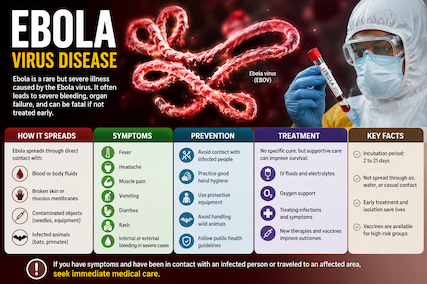
Ebola Virus Disease (EVD) is a rare but serious illness caused by the Ebola virus. It belongs to a group of viruses that can cause viral hemorrhagic fevers, meaning they can affect multiple organs and sometimes lead to bleeding.
Ebola mainly occurs in parts of Africa, particularly in Central and West Africa.
How Does Ebola Spread?
One of the biggest myths is that Ebola spreads easily like the flu. It does not.
Ebola spreads through direct contact with:
Blood or body fluids (saliva, vomit, urine, stool)
Broken skin or mucous membranes (eyes, nose, mouth)
Contaminated objects (needles, medical equipment)
Infected animals (like bats or primates)
Important:
Ebola does NOT spread through air, water, or casual contact like sitting next to someone.
Symptoms of Ebola
Symptoms usually appear 2 to 21 days after exposure.
Early symptoms:
Fever
Fatigue
Muscle pain
Headache
Sore throat
As the disease progresses:
Vomiting and diarrhea
Rash
Impaired kidney and liver function
In some cases, internal or external bleeding
Because early symptoms look like common infections, Ebola can be difficult to recognize at first.
Why Is Ebola So Dangerous?
Ebola can become life-threatening quickly because it:
Affects multiple organs
Causes severe dehydration
Can lead to shock
Without proper care, the mortality rate can be high. However, outcomes improve significantly with early medical treatment and supportive care.
Treatment: Is There a Cure?
There is no simple “pill” for Ebola, but treatment has improved a lot in recent years.
Management includes:
IV fluids and electrolytes
Oxygen support
Blood pressure stabilization
Treatment of secondary infections
Newer therapies and monoclonal antibodies have also improved survival rates in recent outbreaks.
Ebola Vaccines: A Major Breakthrough
One of the biggest advancements in controlling Ebola has been vaccination.
The Ervebo vaccine has been used effectively during outbreaks to protect high-risk populations and healthcare workers.
This has significantly helped reduce the spread of the disease.
How Can You Prevent Ebola?
Prevention is all about avoiding exposure.
Key steps include:
Avoid contact with infected individuals
Use protective equipment in healthcare settings
Practice proper hand hygiene
Avoid handling wild animals or bushmeat in outbreak regions
Follow public health guidelines during outbreaks
Who Is Most at Risk?
Healthcare workers
Family members caring for infected patients
People in outbreak areas
Individuals handling infected animals
Ebola vs Other Viral Illnesses
Ebola is often compared to illnesses like COVID-19 or influenza, but they differ in important ways.
Ebola spreads through direct contact with infected body fluids, whereas COVID-19 primarily spreads through airborne transmission.
In terms of severity, Ebola is often severe and life-threatening, while COVID-19 can range from mild to severe.
Additionally, Ebola outbreaks tend to be localized and contained to specific regions, whereas COVID-19 has demonstrated a global pandemic pattern with widespread transmission.
When Should You Seek Medical Help?
Seek immediate medical care if:
You have symptoms AND
You’ve recently traveled to an outbreak area or had possible exposure
Early isolation and treatment are critical—not just for you, but to protect others.
The Bottom Line
Ebola is a serious disease, but it is not something to panic about in everyday life.
It spreads through specific types of contact, and with modern medical care, vaccines, and public health measures, outbreaks can be controlled much more effectively than before.
Key Message
“Ebola is dangerous—but it is also preventable and controllable with the right precautions.”
Sources:
World Health Organization (WHO)
https://www.who.int/news-room/fact-sheets/detail/ebola-disease
Centers for Disease Control and Prevention (CDC)
National Institutes of Health (NIH)
https://www.nih.gov/research-training/medical-research-initiatives/ebola-researchMédecins Sans Frontières (MSF) – Ebola
https://www.msf.org/ebola
Pulse Your Health
Empowering you to achieve your health goals.
Contact
© 2026. All rights reserved.
Disclaimer: The content on this website is for informational purposes only and is not medical advice. Always seek the advice of your physician or other suitably qualified healthcare professional for diagnosis, treatment and your health related needs.