Stay updated on what is trending in health. Discover tips and resources for a healthier, balanced life.
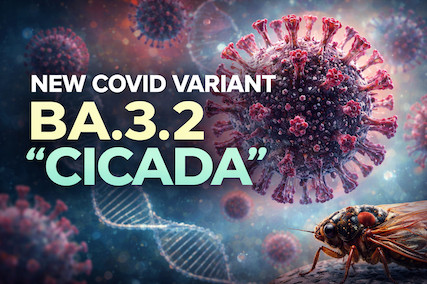
Cicada, the New COVID Variant BA.3.2 – Symptoms and Facts
Learn about Cicada – the new COVID variant of BA.3.2 in 2026: Symptoms, spread, mutations, severity & vaccine effectiveness of this emerging Omicron sub-variant.
NEWS
Dr. S. Ali
3/29/20262 min read
A new COVID-19 variant is making headlines again—and understandably, it’s raising questions.
You may have seen it referred to as BA.3.2 or nicknamed the “Cicada” variant. But what exactly is it? Is it dangerous? And should you be worried?
Let’s break it down in a simple, practical way.
What Is the New COVID Variant BA.3.2?
BA.3.2 is a subvariant of Omicron, the same family of variants that has dominated COVID-19 in recent years.
It was first detected in South Africa in late 2024 and has since spread to multiple countries.
What makes this variant stand out is:
A high number of mutations (over 70 in the spike protein)
Possible increased ability to spread
Potential to partially evade immunity from past infection or vaccination
Because of these features, the World Health Organization has classified it as a “variant under monitoring.”
That means scientists are watching it closely—but it is not currently classified as a major global threat.
Why Is It Called the “Cicada” Variant?
The nickname “Cicada” comes from its unusual pattern.
Like cicadas that stay underground for years and then suddenly appear, this variant:
Emerged quietly
Stayed relatively unnoticed
Then began spreading more visibly later
Where Is It Spreading?
Recent reports show:
Detected in multiple countries worldwide
Found in wastewater samples and travelers
Still a small percentage of total COVID cases in many regions
In other words, it’s spreading—but not dominating globally (yet).
Symptoms of the New COVID Variant
Here’s the reassuring part:
👉 Symptoms are largely similar to previous COVID variants.
Common symptoms include:
Fever
Cough
Sore throat
Fatigue
Headache
Body aches
Runny nose or congestion
Loss of taste or smell (less common now)
Some reports suggest:
More noticeable sore throat
Upper respiratory symptoms (like a cold)
So clinically, it often feels like:
👉 A cold, flu, or mild respiratory infection
Is This Variant More Dangerous?
At this point, there is no strong evidence that BA.3.2 causes more severe illness.
Most cases remain mild to moderate
Severe disease is still more likely in:
Older adults
People with chronic illnesses
Immunocompromised individuals
Health experts emphasize:
👉 The main concern is spread, not severity.
Do Vaccines Still Work?
Yes—this is important.
Even though BA.3.2 may partially evade immunity:
Vaccines are still expected to protect against severe illness, hospitalization, and death
So vaccination and boosters remain relevant.
What Should You Do?
The advice hasn’t really changed:
Stay home if you’re sick
Wear a mask in high-risk settings
Keep vaccinations up to date
Practice good hygiene
If you develop severe symptoms like:
Difficulty breathing
Chest pain
Confusion
👉 Seek medical care immediately.
Should You Be Worried?
Not alarmed—but aware.
Here’s the balanced perspective:
✔ It’s being monitored, not a crisis
✔ Symptoms are similar to previous variants
✔ Vaccines still offer protection against severe disease
✔ It may spread more easily, so surveillance matters
Final Thoughts
COVID-19 hasn’t disappeared—it has simply evolved.
Variants like BA.3.2 remind us of something important:
👉 The virus is still adapting, but so are we.
With better immunity, vaccines, and awareness, most infections today are far less severe than in the early pandemic days.
Related Articles:
1. COVID-19 Vaccines: What You Need to Know (And Why It Still Matters)
2. New COVID Variant NB.1.8.1: How Dangerous Is It? Symptoms, Transmission and Updates
3. Summer COVID-19 Update: Stratus Variant & Rising US Cases
4. XFG & Other COVID-19 Variants: How They’re Changing the Game
5. Long COVID and Brain Fog: Why Some Just Don’t Bounce Back
Sources:
World Health Organization (WHO)
https://www.who.intCenters for Disease Control and Prevention (CDC)
https://www.cdc.gov/covidJohns Hopkins University
https://coronavirus.jhu.eduEuropean Centre for Disease Prevention and Control (ECDC)
https://www.ecdc.europa.eu/en/covid-19UK Health Security Agency (UKHSA)
https://www.gov.uk/government/organisations/uk-health-security-agencyNational Institutes of Health (NIH)
https://www.nih.gov/coronavirusGISAID
https://www.gisaid.orgOur World in Data
https://ourworldindata.org/coronavirus
Pulse Your Health
Empowering you to achieve your health goals.
Contact
© 2026. All rights reserved.
Disclaimer: The content on this website is for informational purposes only and is not medical advice. Always seek the advice of your physician or other suitably qualified healthcare professional for diagnosis, treatment and your health related needs.